
Securing funding for a nascent company is a pivotal moment, often hinging on the selection of the right venture capital (VC) firm. This exploration delves into the landscape of top-tier VC investors specializing in early-stage companies, examining their investment strategies, portfolio successes, and the overall dynamics of this crucial funding ecosystem. We will explore current trends, due diligence processes, and the specific opportunities and challenges within sectors like the travel industry.
Understanding the nuances of early-stage investment is vital for entrepreneurs seeking to navigate the complex world of venture capital. This guide aims to provide clarity and insights into the process, from identifying suitable investors to understanding the various funding stages and the due diligence process involved. We’ll also highlight successful case studies and offer practical advice for navigating this critical phase of business development.
Identifying Top Venture Capital Investors
Securing early-stage funding is crucial for technology startups. Understanding the landscape of venture capital firms and their investment strategies is vital for entrepreneurs seeking capital. This section will identify key players in early-stage tech investments, analyze their approaches, and highlight their portfolio successes.
Top 10 Early-Stage Venture Capital Firms
Numerous venture capital firms specialize in early-stage technology investments. However, consistent performance and reputation distinguish a select few. The following list represents ten prominent firms, though the ranking is not exhaustive or definitive, as performance fluctuates. Investment strategies and typical investment sizes are approximate and can vary based on specific deals and market conditions.
Note: The information below is based on publicly available data and may not reflect the most current figures.
| VC Firm Name | Investment Focus | Typical Investment Size | Notable Portfolio Companies |
|---|---|---|---|
| Sequoia Capital | Software, Biotech, Consumer | $5M – $100M+ | Google, Apple, YouTube, WhatsApp |
| Andreessen Horowitz (a16z) | Software, Fintech, Biotech, Crypto | $1M – $100M+ | Airbnb, Facebook, Stripe, Coinbase |
| Accel | Software, SaaS, Fintech | $1M – $50M | Dropbox, Slack, Spotify, UiPath |
| Lightspeed Venture Partners | Consumer, SaaS, Fintech | $2M – $50M | Snap, Affirm, Grubhub, Udemy |
| Benchmark | Software, Enterprise, Consumer | $1M – $25M | Uber, Twitter, Snapchat, Stripe |
| Kleiner Perkins | Software, Biotech, Cleantech | $5M – $100M+ | Amazon, Google, Genentech, Sun Microsystems |
| Insight Partners | Software, SaaS, Fintech | $5M – $100M+ | Twitter, Shopify, Cloudflare, DataDog |
| Founders Fund | Technology, Space, Biotech | $10M – $100M+ | SpaceX, Palantir, Airbnb |
| Y Combinator | Seed-stage, across various sectors | $125K – $2M | Airbnb, Dropbox, Stripe, Reddit |
| First Round Capital | Seed-stage, across various sectors | $500K – $2M | Uber, Warby Parker, Square |
Comparison of Investment Philosophies
Sequoia Capital, Andreessen Horowitz, and Accel exemplify distinct approaches to early-stage investing. Sequoia emphasizes identifying and backing exceptional founders with potentially transformative ideas, often focusing on long-term value creation. Andreessen Horowitz takes a more thematic approach, investing heavily in sectors they believe are poised for significant growth, like crypto or biotech. Accel, on the other hand, is known for its deep operational expertise and its ability to assist portfolio companies with scaling their businesses.
While all three firms have impressive portfolio companies and high success rates, their strategies differ significantly. Their portfolio companies demonstrate the diverse nature of their investment strategies and risk tolerance.
Early-Stage Investment Trends
The early-stage venture capital landscape is dynamic, constantly evolving with technological advancements and shifting market demands. Current trends reflect a focus on emerging technologies with high growth potential and industries poised for disruption. Investors are increasingly scrutinizing not only the technology itself but also the team, market opportunity, and scalability of the business model.Early-stage investment strategies are becoming more nuanced, with a greater emphasis on data-driven decision-making and a longer-term perspective.
This reflects a shift away from purely speculative investments towards a more rigorous assessment of risk and return. Furthermore, the rise of alternative funding models, such as crowdfunding and angel investors, is influencing the overall early-stage investment ecosystem.
Successful Early-Stage Investments (2018-2023)
The following examples illustrate successful early-stage investments in the past five years, showcasing diverse sectors and the factors that contributed to their success. These examples are not exhaustive but represent significant trends.
- Stripe (Payments): Stripe’s success stems from its innovative approach to online payment processing, offering a developer-friendly API and robust infrastructure. Early investors recognized the massive potential of simplifying online payments for businesses of all sizes, leading to substantial returns. The strong technical foundation and the experienced founding team were key factors in its rapid growth.
- Databricks (Big Data): Databricks leveraged the growing demand for big data analytics by offering a unified platform for data engineering, machine learning, and data science. The company’s strong technological foundation, combined with a talented team and a clear market need, attracted significant investment and propelled its rapid expansion. The ability to seamlessly integrate various big data technologies was a crucial differentiator.
- Instacart (Grocery Delivery): Instacart capitalized on the increasing consumer demand for convenient grocery delivery services. Its early success was driven by a well-executed business model, strong partnerships with grocery retailers, and a user-friendly mobile application. The rapid adoption of online grocery shopping during the COVID-19 pandemic further accelerated its growth.
- Zoom (Video Conferencing): Zoom’s explosive growth during the pandemic demonstrated the power of a well-timed product meeting a significant market need. Its ease of use and reliability quickly made it a dominant player in the video conferencing market, showcasing the importance of product-market fit and adaptability to unforeseen circumstances. The company’s scalable infrastructure also played a crucial role in handling the surge in demand.
- Rivian (Electric Vehicles): Rivian’s success highlights the growing investment in sustainable transportation solutions. Its focus on innovative electric vehicle technology and its strong brand identity resonated with environmentally conscious consumers and investors. Securing strategic partnerships with established automakers and securing significant pre-orders were critical factors in its early success.
Due Diligence and Investment Process
Securing early-stage funding is a rigorous process for startups, demanding thorough preparation and a compelling business plan. Venture capital firms, in turn, undertake extensive due diligence to mitigate risk and identify promising investments. This process involves a multi-faceted evaluation of the company, its team, and its market potential.Early-stage venture capital firms employ a robust due diligence process to assess the viability and potential of a startup before committing capital.
This process goes beyond simply reviewing financial statements; it delves into the intricacies of the business model, the competitive landscape, and the management team’s capabilities. A crucial aspect is validating the market opportunity and assessing the scalability of the business. The depth and breadth of due diligence vary depending on the investment stage and the firm’s internal procedures, but several key aspects are consistently examined.
Due Diligence Key Aspects
The due diligence process typically includes a thorough examination of the startup’s business plan, financial projections, market analysis, competitive landscape, intellectual property, and the management team. This involves scrutinizing financial statements, reviewing legal documents, conducting customer interviews, and assessing the technology’s viability. A critical element is understanding the risks associated with the investment and developing mitigation strategies. The goal is to gain a comprehensive understanding of the company’s strengths and weaknesses, its potential for growth, and the likelihood of a successful exit strategy.
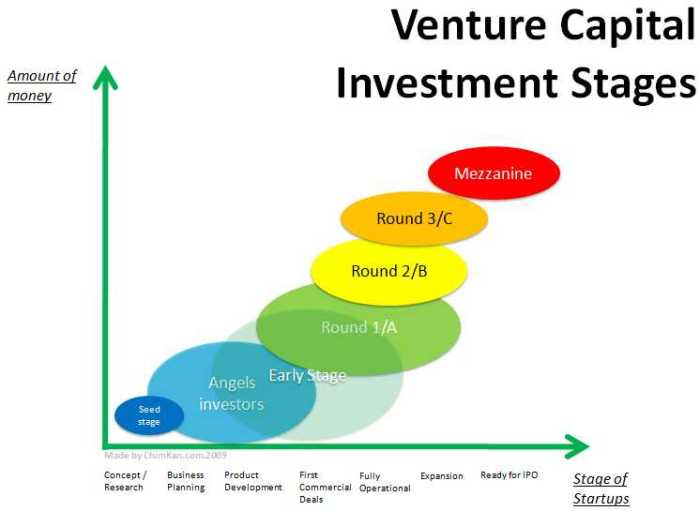
Stages of Early-Stage Funding
Early-stage investments typically follow a phased approach, with each stage representing a milestone in the company’s development and attracting different levels of funding.
- Seed Funding: This initial stage provides capital for product development, market research, and building a minimum viable product (MVP). Example: A biotech startup securing $500,000 to conduct pre-clinical trials and develop a prototype drug.
- Series A Funding: This round typically follows a successful MVP launch and demonstrates early traction. Funds are used for scaling operations, expanding the team, and accelerating growth. Example: A SaaS company raising $2 million to expand its sales and marketing efforts and develop new features.
- Series B Funding: This stage involves substantial investment to fuel significant growth, expand into new markets, and potentially acquire competitors. Example: An e-commerce platform securing $10 million to enhance its logistics infrastructure and expand internationally.
- Series C and beyond: These later-stage funding rounds typically support further expansion, strategic acquisitions, and preparations for an IPO or acquisition. Example: A well-established mobile gaming company raising $50 million to develop new game titles and expand its user base globally.
Investment Process Flowchart
The following describes a typical investment process flowchart. Note that the specific steps and timelines can vary significantly depending on the venture capital firm and the specifics of the investment opportunity.
A simplified representation: Initial Contact → Due Diligence → Term Sheet Negotiation → Legal Documentation → Funding.
Imagine a flowchart with boxes connected by arrows.Box 1: Initial Contact (Startup pitches to VC firm) → Arrow → Box 2: Initial Screening (VC firm reviews pitch deck and initial materials) → Arrow → Box 3: Due Diligence (Thorough investigation of the company, market, team, etc.) → Arrow → Box 4: Term Sheet Negotiation (VC firm and startup negotiate key investment terms) → Arrow → Box 5: Legal Documentation (Legal agreements are drafted and reviewed) → Arrow → Box 6: Funding (VC firm disburses funds to the startup).
Venture Capital and the Travel Industry
Venture capital plays a crucial role in shaping the future of the travel industry, fueling innovation and supporting the growth of companies that are transforming how we plan, book, and experience travel. This influx of capital is particularly significant in sectors like travel technology and sustainable tourism, areas ripe for disruption and offering substantial returns for investors. The industry’s inherent dynamism, coupled with the increasing adoption of technology by travelers, creates a fertile ground for investment.The travel industry, traditionally characterized by established players and fragmented operations, is undergoing a rapid digital transformation.
Venture capital is acting as a catalyst, accelerating the development and deployment of innovative solutions that address consumer needs and improve operational efficiency across the entire travel ecosystem. This includes advancements in areas such as personalized travel planning, seamless booking processes, and sustainable tourism practices.
Examples of Venture-Backed Travel Startups
Several travel-related startups have successfully secured significant venture capital funding, demonstrating the industry’s attractiveness to investors. These companies represent a diverse range of business models and have achieved notable successes in their respective niches.
- Airbnb: Airbnb disrupted the hospitality industry with its peer-to-peer accommodation platform, connecting travelers with unique lodging options worldwide. Its success is attributed to its network effect, a wide selection of properties, and its user-friendly platform. The company’s massive venture capital funding fueled its global expansion and technological advancements.
- Booking.com: While not a pure startup in the traditional sense, Booking.com’s continued growth and innovation have been supported by significant investment over the years. Its comprehensive booking platform offers a vast inventory of accommodations, flights, and rental cars, leveraging technology to optimize search and pricing. Its success stems from its user-friendly interface and comprehensive service offerings.
- Skyscanner: Skyscanner, a metasearch engine for flights, hotels, and car rentals, has received substantial venture capital funding to enhance its search algorithms and expand its global reach. Its business model relies on affiliate marketing, generating revenue through commissions on bookings made through its platform. Its success lies in its ability to aggregate data from various providers and present it in a user-friendly format.
Challenges and Opportunities in Travel Venture Capital
Investing in travel startups presents both significant opportunities and considerable challenges. The sector is characterized by its cyclical nature, sensitivity to global events (such as pandemics and economic downturns), and high competition.The opportunities stem from the continuous growth of the travel market, the increasing adoption of technology by travelers, and the emergence of new travel trends such as sustainable tourism and experiential travel.
However, investors must carefully assess the scalability and resilience of their chosen companies, considering factors such as regulatory compliance, seasonality, and dependence on external factors like airline partnerships or tourism infrastructure. Thorough due diligence and a clear understanding of the market dynamics are essential for successful investment in this dynamic sector.
Travel-Related Topics (Diversification)
The travel industry is vast and multifaceted, offering numerous opportunities for both leisure and business. Understanding various aspects of travel, from budgeting and insurance to photography and visa applications, can significantly enhance the overall experience and minimize potential challenges. This section delves into key travel-related topics, providing practical advice and informative details.
Five Unique Travel Hacks to Save Money and Time
Strategic planning and resourceful techniques can significantly reduce travel expenses and streamline the journey. These hacks focus on maximizing value and minimizing wasted resources.
- Utilize budget airlines and consider alternative airports: Flying into smaller, less popular airports often results in lower fares. Budget airlines, while sometimes offering less comfort, can save substantial amounts on airfare.
- Embrace slow travel: Instead of rushing through multiple destinations, spend more time in fewer places. This approach reduces transportation costs and allows for a deeper immersion in the local culture.
- Take advantage of free activities: Many cities offer free walking tours, museum days, and parks. Researching these options beforehand can dramatically cut down on entertainment expenses.
- Pack light: Avoid checked baggage fees by strategically packing only essential items. This also makes navigating airports and transportation much easier.
- Utilize ride-sharing apps and public transportation: Relying on ride-sharing services or efficient public transportation networks often proves more cost-effective than taxis, especially for longer distances.
Key Aspects of Travel Insurance and Coverage Options
Travel insurance provides crucial financial protection against unforeseen circumstances during a trip. Choosing the right policy depends on individual needs and the nature of the trip.
When purchasing travel insurance, consider the following:
- Trip cancellation/interruption coverage: This covers costs associated with canceling or interrupting a trip due to illness, injury, or unforeseen events.
- Medical expenses coverage: This covers medical costs incurred during the trip, including emergency medical evacuation.
- Baggage loss/delay coverage: This covers the cost of replacing lost or delayed luggage.
- Emergency assistance services: This provides 24/7 access to assistance with medical emergencies, lost documents, and other unforeseen issues.
- Pre-existing condition coverage: Some policies offer coverage for pre-existing conditions, but this often requires additional premiums and may have limitations.
Different insurers offer varying levels of coverage and premium costs. Comparing several options before purchasing a policy is crucial to ensure adequate protection at a reasonable price.
Travel Photography: Capturing Stunning Images and Editing Techniques
Travel photography allows for preserving memories and sharing experiences. Mastering fundamental techniques enhances the quality and impact of travel photos.
Essential elements for successful travel photography include:
- Lighting: The “golden hour” (sunrise and sunset) provides soft, warm light, ideal for landscape and portrait photography. Avoid harsh midday sun, which creates strong shadows.
- Composition: Utilize the rule of thirds, leading lines, and symmetry to create visually appealing images. Experiment with different angles and perspectives.
- Editing: Software like Adobe Lightroom and Photoshop allows for adjustments to brightness, contrast, saturation, and sharpness. Subtle edits enhance the image without making it look artificial.
Ten Essential Travel Tips for First-Time International Travelers
International travel presents unique challenges and opportunities. Preparation and awareness of cultural nuances are key to a smooth and enjoyable experience.
Essential tips for first-time international travelers include:
- Obtain necessary visas and travel documents well in advance.
- Inform your bank and phone provider of your travel plans.
- Learn basic phrases in the local language.
- Research local customs and etiquette.
- Make copies of important documents and store them separately.
- Pack appropriate clothing and medications.
- Stay aware of your surroundings and personal belongings.
- Exchange currency before your trip or use a travel-friendly credit card.
- Utilize reliable transportation options.
- Be open to new experiences and embrace cultural differences.
United States Visa Application Process
The US visa application process involves several steps, including completing an online application, scheduling an interview, and providing supporting documentation.
The process generally includes:
- Completing the DS-160 online application form: This form requires detailed personal and travel information.
- Paying the visa application fee: The fee varies depending on the visa type.
- Scheduling an interview at a US embassy or consulate: This interview assesses the applicant’s eligibility for a visa.
- Gathering supporting documents: This includes proof of financial stability, travel itinerary, and ties to home country.
- Attending the interview: The consular officer will review the application and supporting documents and make a decision.
Detailed instructions and specific requirements are available on the website of the US embassy or consulate in the applicant’s country of residence.
Brochure Design: Urban Escape in New York City
(Imagine a tri-fold brochure. Panel 1: Image of the New York City skyline at sunset. Headline: “Experience the Energy of NYC!”)
Panel 1: Brief overview of NYC, highlighting its vibrant culture, diverse neighborhoods, and iconic landmarks. Call to action: “Discover the ultimate urban adventure.”
Panel 2: Features three key attractions with images: Times Square (bright lights, bustling crowds), Central Park (serene greenery, people relaxing), and the Statue of Liberty (iconic view, historical significance). Brief descriptions of each attraction and suggested activities.
Panel 3: Information on accommodation options (ranging from budget-friendly hostels to luxury hotels), transportation (subway, taxis, walking), and suggested itineraries (one-day, two-day, three-day options). Contact information and website link.
Sample Vacation Packages for Different Budgets and Travel Styles
Vacation packages cater to various preferences and financial constraints, offering tailored experiences.
Examples of vacation packages:
| Package | Budget | Style | Itinerary (Example) | Cost Breakdown (Estimate) |
|---|---|---|---|---|
| Budget Backpacker Europe | $1000 (7 days) | Adventure/Budget | Amsterdam, Paris, Rome (hostels, budget transportation, free activities) | Flights: $500, Accommodation: $200, Activities: $100, Food: $200 |
| Luxury Caribbean Getaway | $5000 (7 days) | Relaxation/Luxury | All-inclusive resort in the Bahamas (private beach, spa treatments, gourmet meals) | Flights: $1000, Accommodation: $3000, Activities: $500, Food: $500 |
| Family Adventure in Orlando | $3000 (7 days) | Family/Theme Park | Orlando, Florida (Theme parks, water parks, family-friendly restaurants) | Flights: $600, Accommodation: $1000, Park Tickets: $1000, Food: $400 |
Structure and Benefits of a Typical Company Vacation Program
Many large companies offer comprehensive vacation programs to benefit their employees.
Typical components of a company vacation program include:
- Paid time off (PTO): Accrued vacation days based on tenure and position.
- Holiday pay: Compensation for designated holidays.
- Travel assistance: Discounted travel rates or partnerships with travel agencies.
- Wellness initiatives: Programs promoting employee well-being and encouraging vacations for stress reduction.
- Flexible work arrangements: Options for remote work or flexible schedules to facilitate vacation planning.
Benefits of such programs include increased employee morale, improved productivity, and reduced stress levels, ultimately contributing to a more positive and productive work environment.
The pursuit of early-stage funding requires a strategic approach, careful consideration of investor alignment, and a thorough understanding of the investment process. By identifying key players, understanding their investment philosophies, and meticulously preparing for due diligence, entrepreneurs can significantly increase their chances of securing the necessary capital to propel their ventures forward. The insights provided here serve as a roadmap for navigating this critical juncture in the life cycle of a startup, emphasizing the importance of preparation and strategic partnership.
FAQ Section
What is the typical return on investment (ROI) for early-stage VC firms?
ROI varies significantly depending on the investment, market conditions, and the success of the portfolio company. While some investments yield substantial returns, others may result in losses. A successful VC firm typically aims for a diversified portfolio to mitigate risk.
How long does the due diligence process usually take?
The duration of due diligence varies depending on the complexity of the deal and the VC firm’s internal processes. It can range from several weeks to several months.
What are some common reasons why VC firms reject investment proposals?
Common reasons include a lack of a clear market opportunity, weak management team, insufficient traction, unrealistic valuations, and inadequate financial projections.
What are some red flags to watch out for when dealing with VC firms?
Red flags can include unrealistic promises, opaque investment terms, lack of transparency, and a high-pressure sales approach.


